Car keys · Hamilton Heights
Transponder Key Programming in Hamilton Heights
The new key slides into the ignition and turns exactly the way the old one did, but the engine only cranks.
In plain words
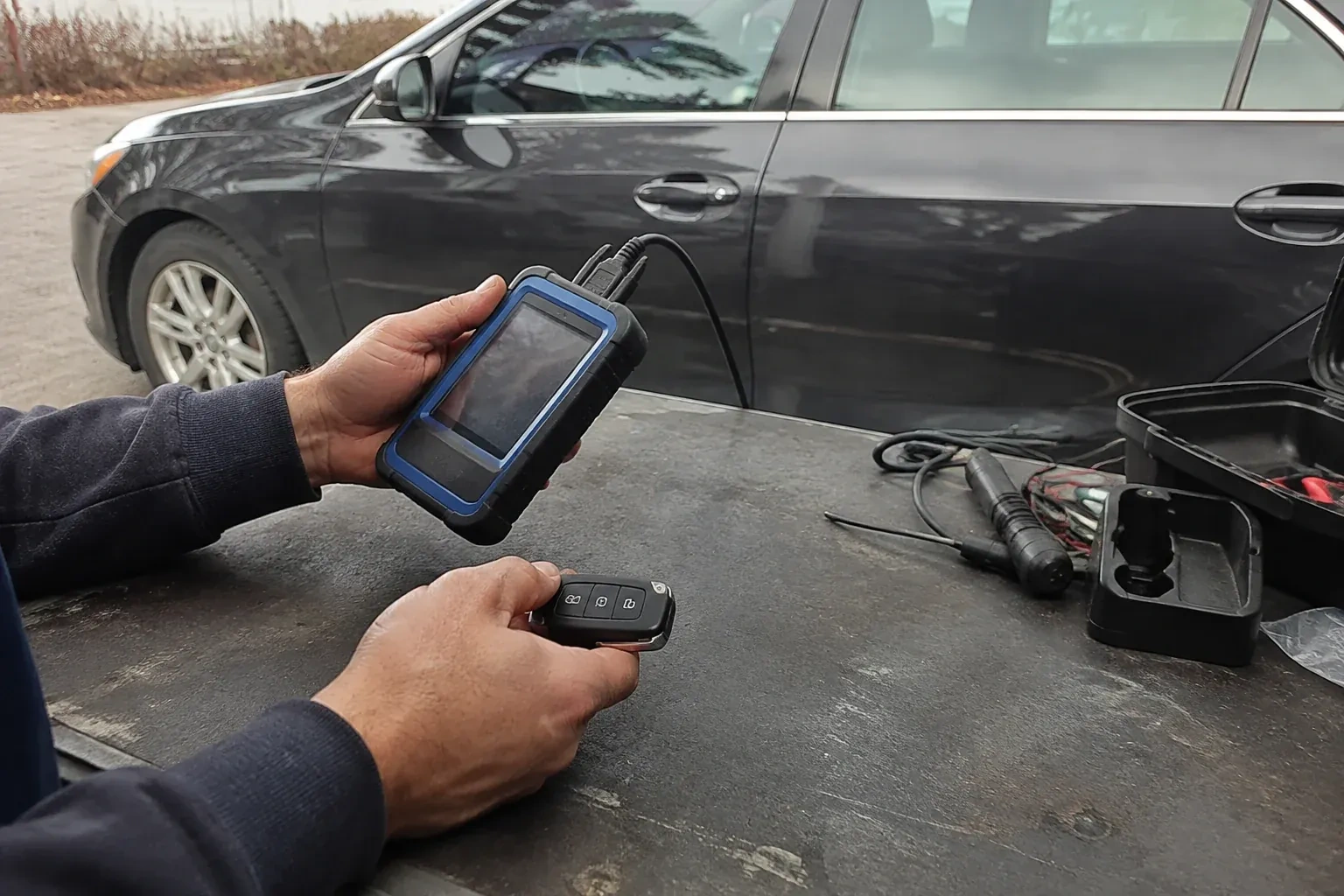
There are really two separate keys hiding inside one piece of metal and plastic: the cut, which is entirely mechanical and opens doors and turns cylinders, and the code, which is electronic and tells the immobilizer to allow the engine to run. A key can be perfectly cut and still leave a car cranking without starting if the code was never written. Programming is the part of the job that handles the code, using equipment built to read and write the exact system fitted to that vehicle.
How the visit goesIt is a cold morning and the fob has to be pressed twice, sometimes three times, before the doors respond, and one week later it stops answering entirely. The metal key still turns the lock by hand, but the dashboard security light stays lit through the whole drive.
Transponder Key Programming
How the visit goes
Anything already added to the vehicle
Aftermarket remote starters, alarms, and a used ignition or control module carried over from another vehicle can all leave their own entries in a key list, sitting alongside the factory ones. Before programming anything new, the locksmith asks what has been added or swapped, since a module transplanted from elsewhere sometimes brings a stranger's old key identities with it. Sorting out what belongs to this vehicle and what arrived with a part keeps the finished key list honest rather than cluttered with entries nobody can explain.
Clearing a lost key's identity
When a key has been lost or stolen, its identity is removed from the immobilizer's memory so that key can no longer start the vehicle, wherever it happens to be. This is done in the same programming session as adding the new key, using the same connection to the vehicle's module. The old key remains a real object that still turns a lock somewhere, but it stops being able to authorize the engine, which is the part of the vehicle that mattered in the first place.
Leaving with a full set of working keys
The visit ends with every key that should work actually tested in the driver's own hands: the new one, and any older ones that were meant to keep working. Remote functions, if the vehicle has them, are checked at a normal distance, and the emergency insert on a proximity fob is pointed out rather than left for the owner to discover later. Nothing is assumed finished on the strength of a screen reporting success; the engine and the fob both had to prove it directly.
Transponder Key Programming
In the van
Security-access module
Diagnostic laptop or tablet
Proximity smart key
Bench programming adapter
Fob battery
Transponder Key Programming
What affects the quote
Whether any working key remains
Adding a spare or a driver's key with an existing key on hand is a more contained job than an all-keys-lost situation, which needs its own extended process to re-establish trust with the vehicle before anything new can be written.
Vehicle make, model and year
The chip family, the immobilizer generation, and how reachable the vehicle's key list is all follow from the exact vehicle, so identifying it precisely early on shapes both the blank needed and how much of the visit is straightforward programming versus a more involved security session.
Time of the appointment
An appointment during regular daytime hours is scoped differently from one outside them, and the locksmith states which applies when the visit is booked so there is no surprise about it on arrival.
What to have ready
- Where is the vehicle parked right now?
- Was a spare ever cut without being programmed?
- Is the dashboard security light flashing or staying lit?
Transponder Key Programming: questions
QuestionsWhat's the difference between cutting a key and programming it?
Cutting shapes a blank to match the lock, so it turns the mechanical cylinder in the door or ignition. Programming is a separate step where the chip inside the key head is taught to the vehicle's immobilizer, so the engine agrees to start. A key can be cut perfectly and still fail to start the car if that second step was skipped, which is the single most common source of confusion in this service.
Can I have a spare key made before I actually need one?
Yes, and on many vehicles it is one of the more straightforward visits in this service, since a working key already on hand can authorize the new one; a few models instead call for two working keys or a different programming route. The spare is cut, its chip is written in, and both keys are tested before the locksmith leaves, so the spare is proven rather than simply handed over untested.
Do I need paperwork from the dealer, or a code from them?
Not usually. Programming equipment reads and writes the vehicle's key list directly in most cases, without needing anything from the dealer. Many recent vehicles gate that access behind a manufacturer-level security session instead, which the locksmith handles as part of the visit rather than asking the owner to obtain anything in advance.
Related services
- Car Key ReplacementAfter fifteen years the blade has worn to a smooth sliver.
- Spare Car Key DuplicationA lockout last month ended with a locksmith opening the door and going home, and the same single key has been carried ever since with nothing behind it.
- Key Fob ProgrammingThe car changed hands last week, and the paperwork included exactly one fob for a household with two drivers.